Upload your WebP file
Drag and drop your WebP image onto the converter area or click to browse your device. You can add multiple files at once for batch conversion.
Convert WebP images to professional TIFF for printing and archiving. Runs entirely in your browser. No server uploads, no registration required.
WebP is a modern web format created by Google — optimized for fast loading but not always accepted by professional print software, desktop publishing tools (InDesign, QuarkXPress), and medical imaging systems. TIFF is the industry standard for these workflows. Converting WebP to TIFF prepares web images for print production and archival storage.
TIFF (Tagged Image File Format) supports lossless compression (LZW), CMYK color space, 16/32-bit depth, multiple layers, and embedded ICC profiles. Transparency from WebP is preserved in TIFF. TIFF files will be significantly larger than WebP — this is expected, as TIFF prioritizes quality over file size.
If you need to edit web images in professional software that doesn't support WebP, converting to TIFF gives you maximum compatibility with print workflows. For general editing, PNG may be a lighter alternative.
This converter processes files locally in your browser — nothing is sent to any server. No registration, no limits, no watermarks.
Businesses, developers, and creators worldwide rely on image format compatibility. Whether you are preparing product images for Amazon, eBay, Etsy, Shopify, optimizing graphics for WordPress, Wix, Squarespace, or converting photos for government portals worldwide, having the right format matters.
TIFF is the industry standard for professional print, archiving, and post-processing workflows. Applications like Adobe Photoshop, Lightroom, and GIMP rely on TIFF for lossless editing. Converting to TIFF preserves full image data including color profiles, layers, and metadata.
For professional photography and print production, TIFF ensures lossless quality that meets industry standards. Whether you are a freelancer, small business owner, or enterprise user, this converter handles your image conversion needs reliably and securely.
| Feature | WebP | TIFF |
|---|---|---|
| Lossy compression | ✓ | — |
| Lossless compression | ✓ | ✓ |
| Transparency (alpha channel) | ✓ | ✓ |
| Animation support | ✓ | — |
| Web browser support | Chrome 32+, Firefox 65+, Edge 18+, Safari 14+ | Safari only |
| Color depth | 8-bit (16.7M) | 8/16/32-bit |
| Compact file size | ✓ | — |
| Metadata (EXIF) | ✓ | ✓ |
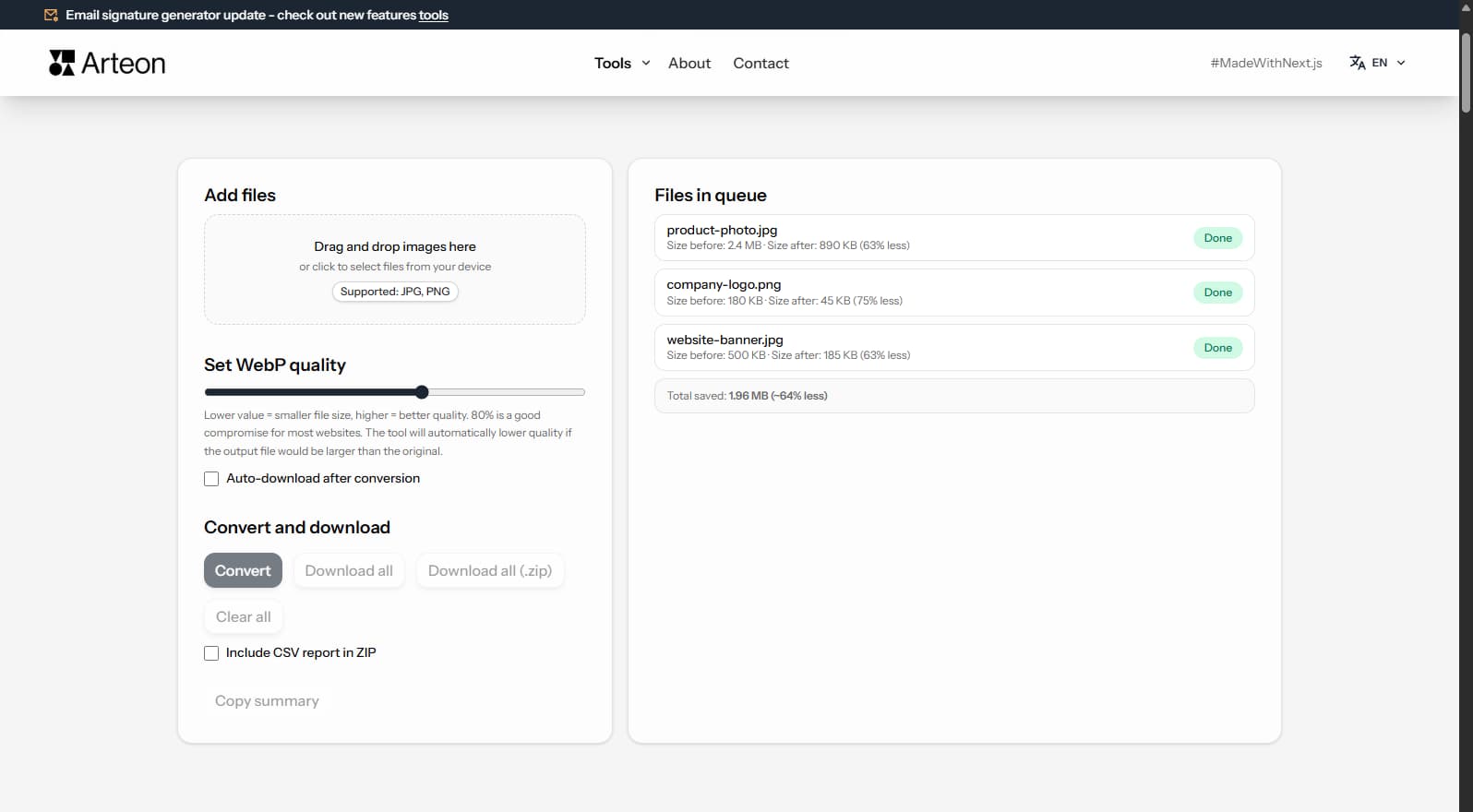
Savings depend on the source file type and its original compression. Below are example results:
Camera photo
2.4 MB → 890 KB
Product image
500 KB → 185 KB
Screenshot / banner
350 KB → 230 KB
Actual savings may vary depending on image content and quality settings. The converter shows the exact size before and after conversion for each file.
Yes, this WebP to TIFF converter is completely free with no limits. You can convert as many files as you need without registration or watermarks.
No. All processing happens locally in your browser using JavaScript and Canvas API. Your files never leave your device, ensuring complete privacy and security.
TIFF supports lossless compression, so you can preserve the original image quality completely. If TIFF also supports lossy mode, you can choose lower quality for smaller files.
Yes, the converter supports batch conversion. You can add multiple WebP files and convert them all to TIFF simultaneously. Use the batch download option to save all converted files at once.
There is no hard file size limit since processing happens in your browser. However, very large files (over 50 MB) may take longer to process depending on your device's available memory and processing power.
Yes, the converter works on any device with a modern web browser, including smartphones and tablets. The interface adapts to your screen size for a comfortable experience on any device.
Yes. All conversion happens locally in your browser using the Canvas API. Files are never sent to any external server. When you close the page, data is automatically cleared.
The TIFF format is widely supported by modern browsers: Chrome, Firefox, Safari, Edge, and Opera.
Have an idea, found a bug, or want to suggest a feature? Drop us a message – we respond within 24 hours.

Resize, crop and convert your image. Ready-made formats for social media, circular avatars, export to JPG/PNG/WebP.

Check title and description length in pixels. Live Google preview and optimization tips.
Convert PNG files to JPG in your browser. No file limits, no signup, no server uploads.

Create a complete favicon.ico set for your website from one image. All required sizes, no login.

Generate 9 palettes from one color: monochromatic, complementary, triadic and more. HEX codes.
Convert WebP files to universally compatible JPG. Works in every app and platform.

Check text and background contrast per WCAG 2.1 AA and AAA. Automatic color correction.

Create a QR code for a website, vCard business card or print. Export PNG and SVG, no registration.

Count words, characters, sentences and reading time. Check readability with the Flesch-Kincaid score.