Upload your JPG file
Drag and drop your JPG file onto the converter or click to browse.
Convert JPG images to PDF documents. Combine multiple files into one PDF. Free, no registration.
JPG is the most common photo format, but sharing multiple photos individually is inconvenient. Converting JPG to PDF packages images into a single multi-page document that is universally readable, easy to share via email, and accepted by every print shop and government agency.
JPG to PDF conversion is essential for creating photo portfolios, scanning documents (receipts, contracts, IDs), preparing files for printing, and archiving photos in a format that preserves the original resolution and can be viewed on any device.
This converter processes files locally in your browser — nothing is sent to any server. No registration, no limits, no watermarks.
| Feature | JPG | |
|---|---|---|
| Lossy compression | ✓ | — |
| Lossless compression | — | ✓ |
| Transparency (alpha channel) | — | ✓ |
| Animation support | — | — |
| Web browser support | All browsers | Built-in PDF viewer |
| Compact file size | ✓ | — |
| Metadata (EXIF) | ✓ | — |
The quality slider lets you set a value from 60% to 95%. Higher values mean better image quality but larger file sizes.
At 85% quality, the visual difference between the original JPG and the resulting PDF is virtually imperceptible to the naked eye, while the file is significantly smaller.
A few tips to help you avoid common issues during conversion:
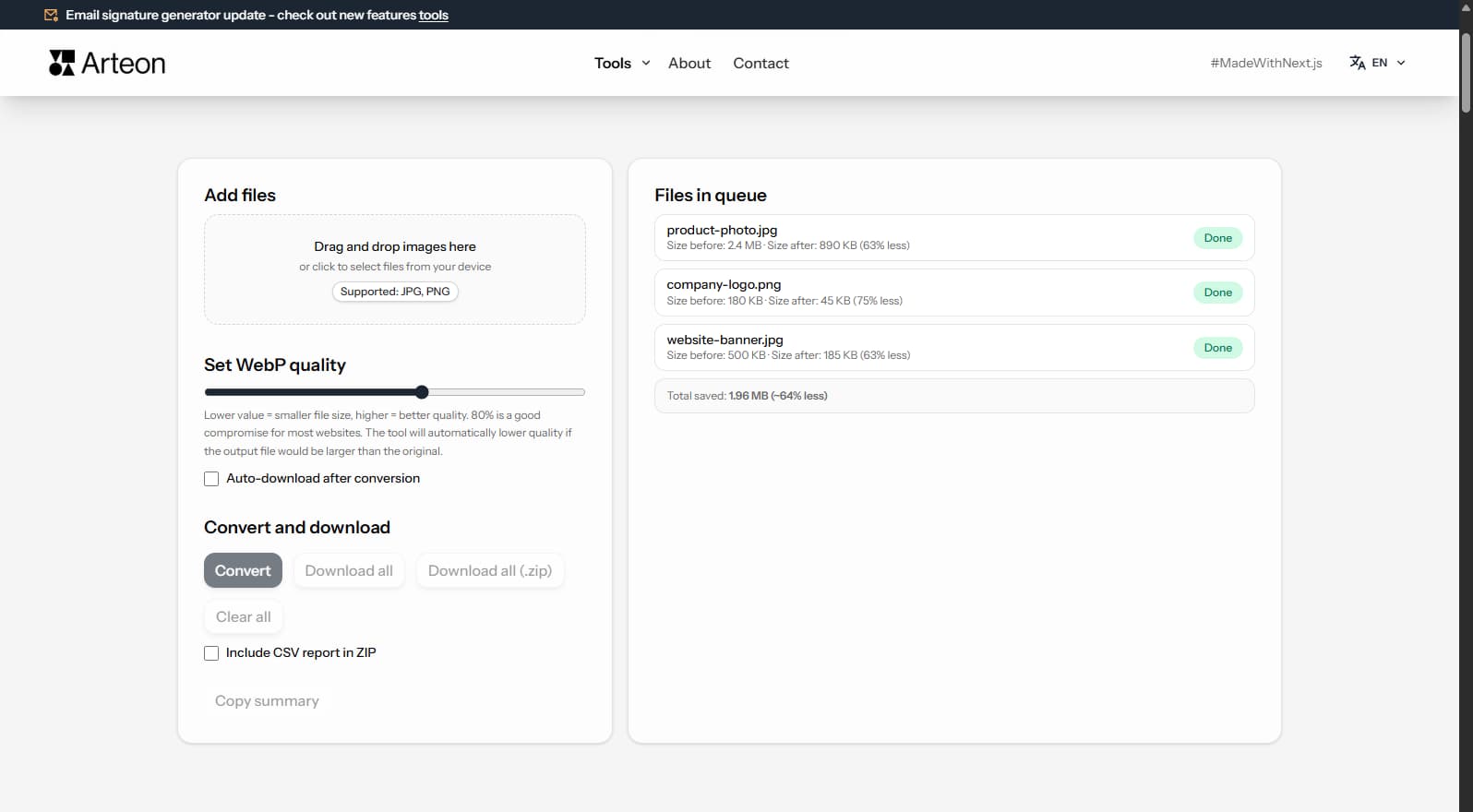
Savings depend on the source file type and its original compression. Below are example results:
Camera photo
2.4 MB → 890 KB
Product image
500 KB → 185 KB
Screenshot / banner
350 KB → 230 KB
Actual savings may vary depending on image content and quality settings. The converter shows the exact size before and after conversion for each file.
While JPG to PDF conversion creates documents rather than web images, it's worth noting that PDF files embedded or linked on websites also affect page performance. Large PDFs slow down downloads and frustrate users.
When creating PDFs from JPG images, use appropriate quality settings. For web-shared PDFs, quality 80–85 produces files that look great while keeping the PDF size manageable. For print, use quality 90–95.
If you need to display the images on a web page rather than in a PDF, consider converting to WebP or AVIF instead for optimal web performance.
Yes, this converter is completely free with no limits. No registration, no watermarks.
No. All processing happens locally in your browser. Your files never leave your device.
Yes, the converter supports batch conversion. Add multiple files and convert them all simultaneously.
Yes, the converter works on any device with a modern web browser, including smartphones and tablets.
Yes. All conversion happens locally in your browser using the Canvas API. Files are never sent to any external server. When you close the page, data is automatically cleared.
Yes. JPG files are added to the PDF in the order you upload them. You can rearrange the order before conversion by dragging files in the list.
The PDF format is widely supported by modern browsers: Chrome, Firefox, Safari, Edge, and Opera.
Have an idea, found a bug, or want to suggest a feature? Drop us a message – we respond within 24 hours.

Resize, crop and convert your image. Ready-made formats for social media, circular avatars, export to JPG/PNG/WebP.

Check title and description length in pixels. Live Google preview and optimization tips.
Convert PNG files to JPG in your browser. No file limits, no signup, no server uploads.

Create a complete favicon.ico set for your website from one image. All required sizes, no login.

Generate 9 palettes from one color: monochromatic, complementary, triadic and more. HEX codes.
Convert WebP files to universally compatible JPG. Works in every app and platform.

Check text and background contrast per WCAG 2.1 AA and AAA. Automatic color correction.

Create a QR code for a website, vCard business card or print. Export PNG and SVG, no registration.

Count words, characters, sentences and reading time. Check readability with the Flesch-Kincaid score.