1. Add WebP files
Drag your WebP images onto the upload area or click to select them. No limit on files.
Convert WebP files to lossless PNG. Add images, convert instantly in your browser, and download. Nothing is uploaded to any server.
WebP is optimized for web delivery but not every application supports it — older versions of Photoshop, Microsoft Office, legacy CMS systems, and some print workflows require PNG. Converting WebP to PNG gives you a universally supported lossless format that works everywhere.
PNG supports full alpha transparency, millions of colors, and is natively supported by every browser, operating system, and image editor. The conversion is lossless — every pixel from the decoded WebP is preserved exactly in the PNG output.
PNG files will be larger than WebP because PNG uses less aggressive compression. If you need a compact format, keep the WebP. If you need universal compatibility and lossless quality, PNG is the right choice.
All processing happens locally in your browser — nothing is sent to any server. No registration, no limits, no watermarks.
Quick steps:
Common use cases:
| Feature | WebP | PNG |
|---|---|---|
| Lossy compression | ✓ | — |
| Lossless compression | ✓ | ✓ |
| Transparency (alpha channel) | ✓ | ✓ |
| Animation support | ✓ | — |
| Web browser support | Chrome 32+, Firefox 65+, Edge 18+, Safari 14+ | All browsers |
| Color depth | 8-bit (16.7M) | 8/16-bit |
| Compact file size | ✓ | — |
| Metadata (EXIF) | ✓ | — |
Core Web Vitals is a set of performance metrics Google uses when evaluating websites. One of them - LCP (Largest Contentful Paint) - measures the time it takes for the largest visible element to appear on screen. On many pages, that element is an image.
Converting WebP images to PNG reduces graphic file sizes, which directly shortens resource download time and improves the LCP score. Smaller files mean faster page loading - especially important on mobile devices with slower connections. Additional techniques like loading="lazy" and fetchpriority="high" speed up rendering.
Tools like PageSpeed Insights and Lighthouse identify specific files worth optimizing.
A few tips to help you avoid common issues during conversion:
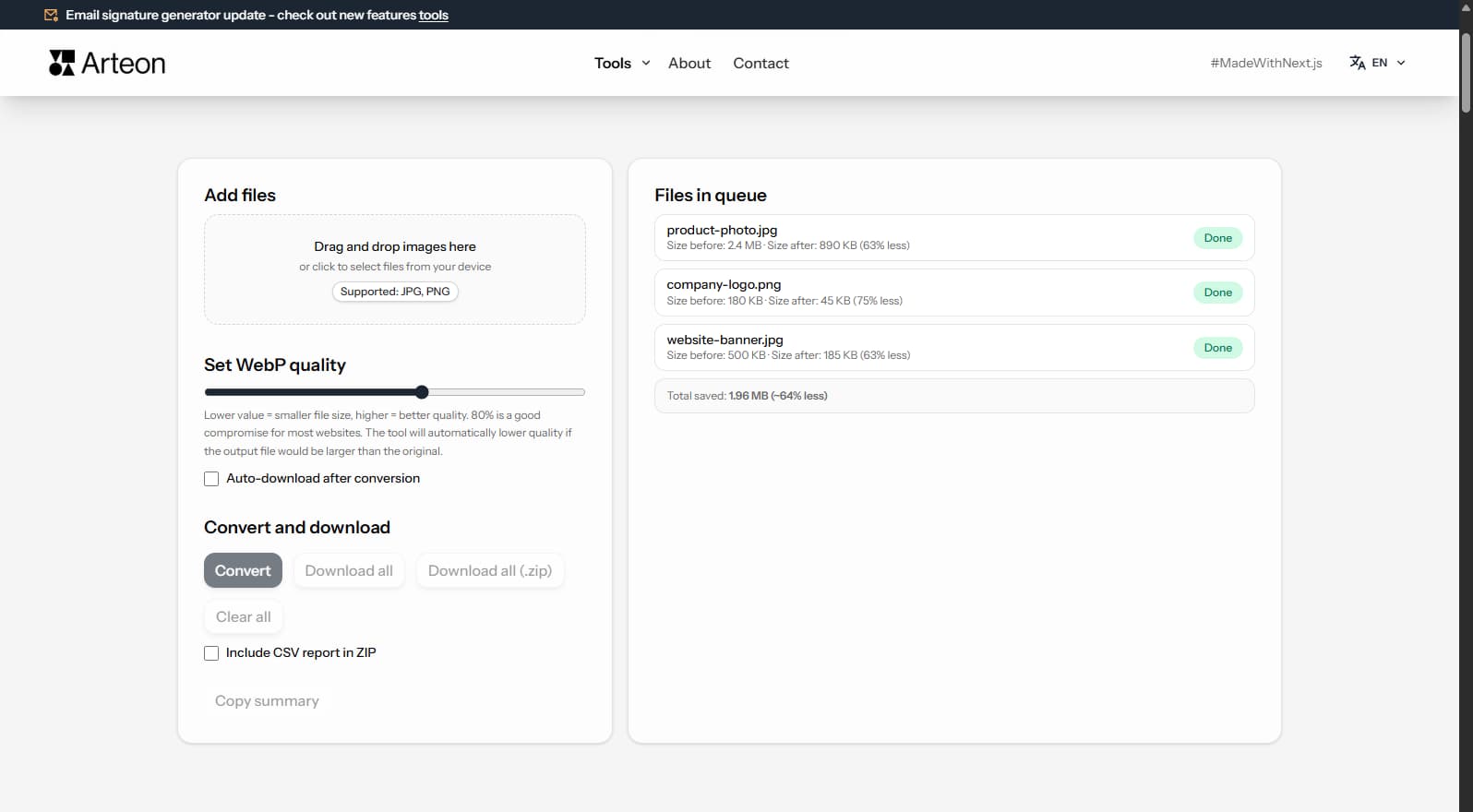
Savings depend on the source file type and its original compression. Below are example results:
Camera photo
2.4 MB → 890 KB
Product image
500 KB → 185 KB
Screenshot / banner
350 KB → 230 KB
Actual savings may vary depending on image content and quality settings. The converter shows the exact size before and after conversion for each file.
WebP can use either lossy or lossless compression, while PNG is always lossless. The conversion decodes the WebP data and saves every pixel exactly as-is in PNG format. No additional quality loss occurs.
PNG files will be larger than the original WebP — typically 2–5× larger depending on image content. This is expected because PNG uses less aggressive (but lossless) Deflate compression.
If file size is a concern, keep the WebP format. Convert to PNG only when you need universal compatibility with applications that do not support WebP (older Photoshop versions, Microsoft Office, legacy CMS systems).
PNG files are larger than WebP because PNG uses lossless compression while WebP uses lossy:
Photo
WebP: 240 KB → PNG: 1.2 MB
5× larger (lossless)
Screenshot
WebP: 85 KB → PNG: 320 KB
3.8× larger (lossless)
Icon with transparency
WebP: 12 KB → PNG: 28 KB
2.3× larger (lossless)
The size increase is normal. PNG prioritizes universal compatibility and lossless quality over file size.
No. PNG is a lossless format, so no quality is lost during conversion. The output is a pixel-perfect copy of the original WebP.
Usually yes. PNG uses lossless compression, which preserves all data. WebP achieves smaller sizes through more advanced compression.
Yes. If the original WebP has an alpha channel, the resulting PNG will retain full transparency.
Yes. Add as many files as you like - no limit.
No. Everything runs locally in your browser via the Canvas API.
Individual files up to 100 MB are supported.
Yes. Use our <a href="/en/tools/png-to-webp-converter">PNG to WebP converter</a>.
Yes, but a desktop or laptop is recommended for the best experience.
Have an idea, found a bug, or want to suggest a feature? Drop us a message - we respond within 24 hours.

Resize, crop and convert your image. Ready-made formats for social media, circular avatars, export to JPG/PNG/WebP.

Check title and description length in pixels. Live Google preview and optimization tips.
Convert PNG files to JPG in your browser. No file limits, no signup, no server uploads.

Create a complete favicon.ico set for your website from one image. All required sizes, no login.

Generate 9 palettes from one color: monochromatic, complementary, triadic and more. HEX codes.
Convert WebP files to universally compatible JPG. Works in every app and platform.

Check text and background contrast per WCAG 2.1 AA and AAA. Automatic color correction.

Create a QR code for a website, vCard business card or print. Export PNG and SVG, no registration.

Count words, characters, sentences and reading time. Check readability with the Flesch-Kincaid score.