Upload your SVG file
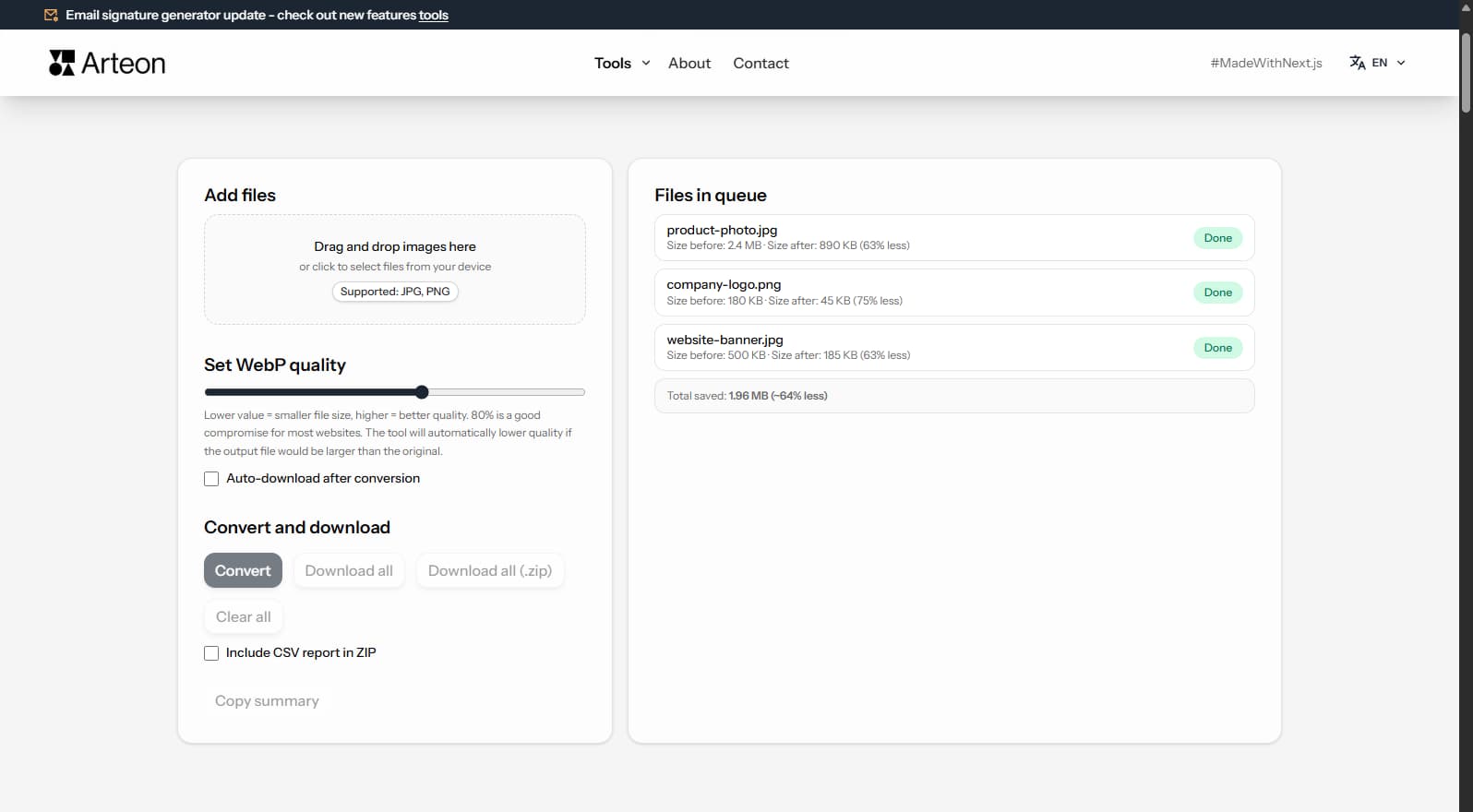
Drag and drop your SVG image onto the converter area or click to browse your device. You can add multiple files at once for batch conversion.
Convert vector SVG to lightweight WebP. Ideal for websites and social media. Free browser-based tool - no signup, no file limits, complete privacy.
SVG is a vector format ideal for logos, icons, and diagrams. However, some platforms do not support SVG — email clients (Outlook, Gmail), social media (Instagram, Facebook), and certain CMS systems require raster images. Converting SVG to WebP creates a compact raster image with excellent compression.
WebP is supported by all modern browsers and offers 25–35% better compression than PNG at comparable quality. It supports alpha transparency, so transparent backgrounds from your SVG are preserved.
Note that converting vector (SVG) to raster (WebP) is a one-way process — the output cannot be scaled to arbitrary sizes without quality loss. Keep the original SVG for editing. Use WebP for platforms that require raster images.
All processing happens locally in your browser — nothing is sent to any server. No registration, no limits, no watermarks.
Businesses, developers, and creators worldwide rely on image format compatibility. Whether you are preparing product images for Amazon, eBay, Etsy, Shopify, optimizing graphics for WordPress, Wix, Squarespace, or converting photos for government portals worldwide, having the right format matters.
Modern web standards increasingly favor efficient formats. Google PageSpeed Insights and Core Web Vitals metrics reward pages that use optimized images. Converting SVG to WebP can directly improve your Largest Contentful Paint (LCP) score, which impacts both search rankings and user experience.
For email marketing campaigns and social media, WebP provides excellent compression while maintaining visual quality. Whether you are a freelancer, small business owner, or enterprise user, this converter handles your image conversion needs reliably and securely.
| Feature | SVG | WebP |
|---|---|---|
| Lossy compression | — | ✓ |
| Lossless compression | ✓ | ✓ |
| Transparency (alpha channel) | ✓ | ✓ |
| Animation support | ✓ | ✓ |
| Web browser support | All browsers | Chrome 32+, Firefox 65+, Edge 18+, Safari 14+ |
| Color depth | N/A (vector) | 8-bit (16.7M) |
| Compact file size | ✓ | ✓ |
| Metadata (EXIF) | — | ✓ |
The quality slider lets you set a value from 60% to 95%. Higher values mean better image quality but larger file sizes.
Since SVG is a vector format, the WebP output quality depends on the rasterization resolution. Make sure the output dimensions match your needs before converting.
SVG files are typically small (5–100 KB) since they store vector data as text. Converting to WebP makes sense when:
For web use where SVG is supported, keep the original SVG — it scales to any size and is typically smaller. Use WebP only when SVG is not an option.
Yes, this SVG to WebP converter is completely free with no limits. You can convert as many files as you need without registration or watermarks.
No. All processing happens locally in your browser using JavaScript and Canvas API. Your files never leave your device, ensuring complete privacy and security.
WebP supports lossless compression, so you can preserve the original image quality completely. If WebP also supports lossy mode, you can choose lower quality for smaller files.
Yes, the converter supports batch conversion. You can add multiple SVG files and convert them all to WebP simultaneously. Use the batch download option to save all converted files at once.
WebP is supported by Chrome, Firefox, Safari 14+, Edge. For older browsers that don't support WebP, you can use the HTML <picture> element to provide a fallback format like JPG or PNG.
There is no hard file size limit since processing happens in your browser. However, very large files (over 50 MB) may take longer to process depending on your device's available memory and processing power.
Yes, the converter works on any device with a modern web browser, including smartphones and tablets. The interface adapts to your screen size for a comfortable experience on any device.
Have an idea, found a bug, or want to suggest a feature? Drop us a message - we respond within 24 hours.

Resize, crop and convert your image. Ready-made formats for social media, circular avatars, export to JPG/PNG/WebP.

Check title and description length in pixels. Live Google preview and optimization tips.
Convert PNG files to JPG in your browser. No file limits, no signup, no server uploads.

Create a complete favicon.ico set for your website from one image. All required sizes, no login.

Generate 9 palettes from one color: monochromatic, complementary, triadic and more. HEX codes.
Convert WebP files to universally compatible JPG. Works in every app and platform.

Check text and background contrast per WCAG 2.1 AA and AAA. Automatic color correction.

Create a QR code for a website, vCard business card or print. Export PNG and SVG, no registration.

Count words, characters, sentences and reading time. Check readability with the Flesch-Kincaid score.